
Choosing a Cast Resin Dry Type Transformer in 2026 requires more than comparing price, capacity, and delivery dates. The right decision begins with the installation itself: a dusty workshop, a humid coastal plant, a hospital basement, or a rooftop substation each creates different risks. Load profiles matter too. Motors, variable-speed drives, solar inverters, and data-center equipment can produce harmonics and sudden thermal stress.
Martin Heathcote, a recognized transformer specialist and author of The J&P Transformer Book, describes transformers as “one of the most efficient machines ever devised.” That efficiency still depends on correct selection, installation, and maintenance. A cast resin design can reduce fire concerns and eliminate liquid leakage, but it is not automatically suitable for every environment. Engineers should examine rated power, insulation level, cooling method, short-circuit strength, noise limits, altitude, humidity, and enclosure protection. Small details matter. A blocked ventilation path can raise winding temperature.
In 2026, buyers should also request evidence of routine and type testing, applicable IEC compliance, partial-discharge performance, and documented quality controls. Ask how the manufacturer handles thermal imaging, resin inspection, spare parts, and service response. Do not rely on a polished brochure alone. Real projects often expose uncomfortable gaps between laboratory data and site conditions. Even experienced teams can overlook future load growth or harmonic distortion. A careful choice balances safety, efficiency, reliability, lifecycle cost, and honest uncertainty. That last part is easy to neglect.
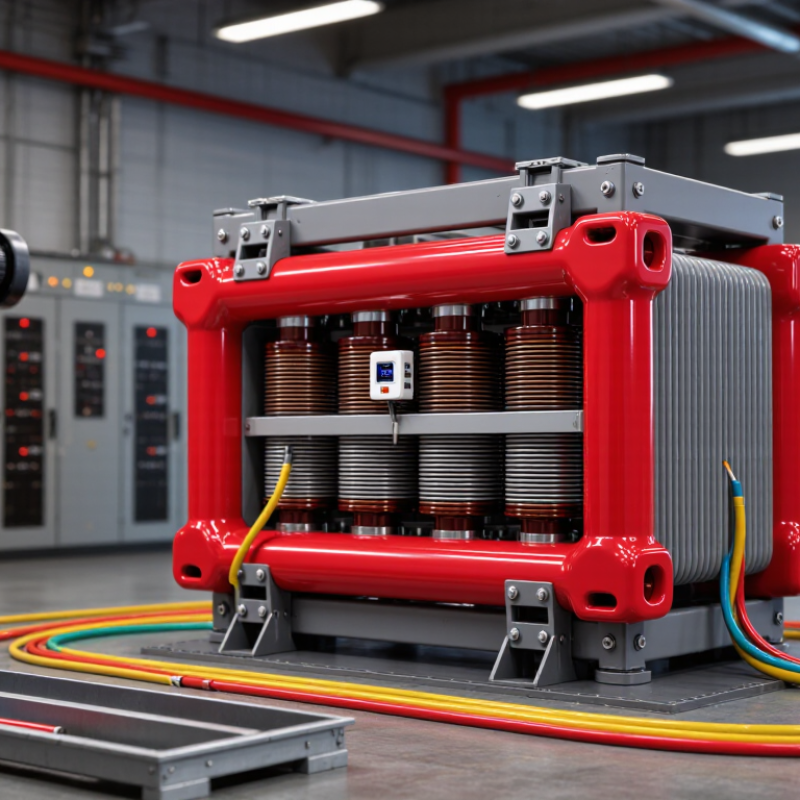
A cast resin dry type transformer transfers electrical energy without insulating oil. Its windings are embedded in cured epoxy resin. No oil is involved. This solid insulation protects copper conductors from moisture, dust, and many mechanical stresses. The transformer usually uses a laminated steel core, high-voltage windings, low-voltage windings, and an air-cooled enclosure.
Its operating principle is straightforward. Alternating current enters the primary winding and produces a changing magnetic flux in the core. That flux induces voltage in the secondary winding through electromagnetic induction. The turns ratio controls the voltage change. During operation, electrical losses create heat inside the windings and core. Cooling air must remove this heat through natural circulation or assisted ventilation.
Choosing a suitable unit requires more than matching voltage and capacity. Check the continuous load, starting current, harmonics, ambient temperature, altitude, and available ventilation. Resin insulation improves fire performance, but it does not make poor installation harmless. Maintenance teams should inspect terminals, air passages, enclosure condition, and unusual noise. Partial discharge test data can reveal insulation weaknesses before failure. Relevant technical standards and independent test records also deserve attention. A common mistake is selecting only by rated kVA. Actual load patterns matter. A lightly loaded unit may still face severe heat cycles or harmonic stress. Field conditions can be less predictable than design sheets suggest. That deserves careful review.
Choosing a cast resin dry type transformer in 2026 starts with measured load data, not a quick nameplate estimate. Record peak demand, motor starting current, harmonics, and future expansion. The IEA’s Electricity 2024 report expects global electricity demand to grow by an average of 3.3% annually through 2026. That growth can make a small capacity margin risky. Select continuous kVA above the calculated maximum, then check ambient temperature, altitude, enclosure ventilation, and duty cycle. A 20% spare margin is common practice, but it is not universally correct.
Voltage selection must match the actual system. Verify primary voltage, secondary voltage, frequency, tap range, grounding method, and short-circuit level. IEC 60076-11 covers dry-type transformer requirements, including temperature-rise and dielectric performance. Compare impedance, no-load loss, load loss, sound level, and insulation class. IEEE guidance also supports evaluating harmonics and non-linear loads. A transformer may have enough kVA yet overheat under a distorted waveform. That detail is easy to miss. My own practical preference is to request factory test records and review them against the project’s measured conditions, although site data is sometimes incomplete.
Tips: Ask for routine test results, thermal calculations, and a clear derating curve. Check voltage regulation at full load. Confirm the transformer can withstand the available fault current. Do not accept a generic “high efficiency” statement without loss figures. The U.S. Department of Energy’s recent transformer supply-chain review also highlights extended procurement risks, so verify lead time before finalizing the electrical schedule. A rushed specification often creates a costly correction later.
| Selection Dimension | What to Confirm | Practical Data or Calculation | Typical Design Guidance | Selection Result |
|---|---|---|---|---|
| Rated Apparent Power | Calculate the transformer capacity from the connected load, demand factor, and future expansion allowance. | Required kVA = Connected kVA × Demand Factor × (1 + Expansion Margin) | For example, 800 kVA connected load × 0.80 demand factor × 1.20 expansion margin = 768 kVA. Select the next standard rating, such as 800 kVA, subject to the load profile and installation conditions. | Size with margin |
| Load Profile | Identify continuous, intermittent, motor-starting, non-linear, and rapidly fluctuating loads. | Record peak kVA, average kVA, load duration, and starting current. | A transformer operating close to its nameplate rating for long periods may require a larger rating or enhanced cooling. Short-duration overload capability must be confirmed with the manufacturer and applicable standard. | Review duty cycle |
| Primary Voltage | Match the transformer primary winding to the utility or facility distribution voltage. | Common medium-voltage levels include 3.3 kV, 6.6 kV, 10 kV, 11 kV, and 13.8 kV. | The selected voltage must match the system nominal voltage, insulation level, grounding arrangement, and utility requirements. Confirm whether the stated voltage is line-to-line and whether a voltage tolerance applies. | Must match system |
| Secondary Voltage | Match the low-voltage winding to the downstream switchgear, motor control centers, and distribution equipment. | Typical three-phase outputs include 400 V, 415 V, 480 V, and 600 V. | Select the actual system voltage rather than relying on a nominal regional value. Check compatibility with equipment voltage ratings and expected voltage drop under full load. | Must match equipment |
| Frequency | Confirm the supply frequency and whether the transformer will operate on a 50 Hz or 60 Hz system. | Standard power-system frequencies are 50 Hz and 60 Hz. | A transformer designed for one frequency should not be applied to another without confirming flux density, temperature rise, losses, and applicable certification. | Confirm before purchase |
| Phase and Vector Group | Verify three-phase operation, winding connection, phase displacement, and neutral availability. | Common arrangements include delta primary and grounded-wye secondary, with vector groups such as Dyn11 or Dyn1. | The vector group must coordinate with parallel transformers, system protection, phase rotation, and the required secondary neutral. Parallel operation requires matching ratio, impedance, vector group, and tap position. | Coordinate system-wide |
| Voltage Regulation | Assess the acceptable secondary-voltage variation from no-load to full-load operation. | Typical impedance values for distribution units are approximately 4%–8%, depending on rating and design. | Lower impedance generally improves voltage regulation but increases prospective short-circuit current. Calculate both voltage drop and fault current before finalizing the design. | Balance two requirements |
| Impedance and Fault Level | Ensure transformer impedance is compatible with protection settings and the short-circuit withstand rating of downstream equipment. | Approximate full-load secondary fault current: IFL ÷ Z per-unit. | For a 1,000 kVA, 480 V, three-phase transformer with 5% impedance, full-load current is about 1,202 A and the idealized transformer-limited fault current is about 24 kA before system impedance is considered. | Verify fault study |
| Efficiency and Losses | Compare no-load loss, load loss, total loss, and expected annual energy consumption. | Efficiency = Output Power ÷ (Output Power + No-Load Loss + Load Loss) | No-load loss occurs whenever the transformer is energized; load loss rises approximately with the square of current. Use the actual operating load profile rather than comparing only nameplate efficiency. | Use lifecycle cost |
| Harmonic Loading | Identify rectifiers, variable-frequency drives, UPS systems, data-center power supplies, and other non-linear loads. | Request harmonic spectrum, total harmonic current distortion, and transformer K-factor or harmonic-loss evaluation. | If harmonic current is significant, consider a transformer designed for the calculated harmonic losses, suitable winding configuration, and an adequately rated neutral conductor. | Perform harmonic study |
| Temperature Rise and Cooling | Confirm the rated ambient temperature, altitude, enclosure ventilation, and cooling method. | Common dry-type cooling designations include AN (air natural) and AF (air forced). | High ambient temperature, restricted airflow, solar exposure, or altitude above 1,000 m may require derating or special design. Keep manufacturer-specified clearances around ventilation openings. | Check site conditions |
| Insulation and Dielectric Level | Confirm insulation class, withstand voltage, partial-discharge performance, and system overvoltage exposure. | Specify rated insulation level and power-frequency withstand requirements according to the applicable voltage class and standard. | Cast resin windings provide solid insulation, but the complete installation still requires suitable surge protection, grounding, clearances, and coordination with the system insulation level. | Specify test requirements |
| Environmental Conditions | Evaluate indoor or outdoor installation, humidity, dust, corrosive gases, salt exposure, seismic activity, and fire-risk requirements. | Select an enclosure protection level such as IP00, IP21, or a higher rating when required by the installation. | Cast resin transformers are suitable for many indoor applications, but the enclosure and materials must be selected for the actual environment. Outdoor placement usually requires a weatherproof enclosure and additional protection. | Define site environment |
| Noise Level | Check acoustic limits for offices, hospitals, residential buildings, and other noise-sensitive locations. | Request guaranteed sound-pressure or sound-power data measured under a stated test method. | Noise is influenced by core flux density, magnetostriction, enclosure design, mounting, and room acoustics. Anti-vibration pads and proper anchoring can reduce structure-borne noise. | Obtain guaranteed value |
| Fire and Smoke Performance | Confirm the required fire behavior for the building, occupancy, and installation location. | Specify applicable flame-retardant, self-extinguishing, smoke, and fire-test requirements. | Cast resin units avoid liquid dielectric leakage, but resin composition and the complete enclosure still need to satisfy the project fire-safety specification and local regulations. | Check code compliance |
| Tap Arrangement | Determine whether the transformer needs off-circuit taps to compensate for supply-voltage variation. | Common arrangements include ±2 × 2.5% or ±5% total adjustment, subject to the design specification. | Off-circuit taps may only be changed when the transformer is de-energized and isolated. Confirm tap range, position indication, and operating instructions. | Match utility voltage |
| Standards and Testing | Define the required manufacturing standard, routine tests, type tests, and special tests. | IEC 60076-11 is commonly used for dry-type power transformers; IEEE C57.12.01 is used in applicable North American projects. | Typical routine tests include winding resistance, ratio and phase displacement, impedance and load loss, no-load loss and current, dielectric tests, and partial-discharge testing where specified. | List tests in specification |
| Maintenance and Monitoring | Determine inspection, cleaning, temperature monitoring, and alarm requirements. | Potential accessories include winding temperature sensors, PT100 or PTC devices, cooling fans, trip contacts, and surge protection. | Dry-type transformers do not require liquid testing, but terminals, ventilation paths, enclosure condition, grounding, and accumulated dust should be inspected according to the maintenance plan. | Plan lifecycle service |
| Final specification checklist: rated kVA, primary and secondary voltage, frequency, phase and vector group, tap range, impedance, insulation level, temperature rise, cooling method, enclosure rating, environmental conditions, sound level, fire requirements, applicable standards, routine tests, and required accessories. | ||||
Grid expansion is accelerating. The IEA Electricity 2024 report expects global electricity demand to grow by about 3.4% annually through 2026. That growth makes transformer efficiency and resilience more important, especially in hospitals, factories, and data centers.
Start with the insulation system, not the nameplate alone. Class F insulation withstands 155°C, while Class H withstands 180°C. Higher thermal capability can support difficult duty cycles, but it does not excuse poor ventilation or excessive loading.
Cooling selection should match the real operating profile. AN cooling uses natural air and usually offers simpler maintenance. AF cooling adds fans for higher short-term capacity. However, fans introduce noise, moving parts, and another failure point. In a dusty production room, I would not specify AF automatically.
The IEC 60076-11 framework also distinguishes environmental performance, including C1 and C2 climatic categories and E1 and E2 behavior under humidity, condensation, and pollution. Those ratings matter near loading docks, coastal sites, and unheated buildings.
Check the enclosure separately. IEC 60529 IP ratings help define protection against dust and water, but an IP rating cannot repair weak site design. The U.S. Department of Energy’s 2024 distribution-transformer rule highlights the continuing value of reducing no-load and load losses.
Even so, I have seen projects overfocus on efficiency and underfund temperature monitoring. That choice deserves reconsideration. A resin-cast unit should include temperature sensors, clear airflow paths, and documented testing under expected ambient conditions.
Safety should be checked beyond the product label. Look for cast resin insulation, temperature sensors, and suitable fire-performance documentation. A robust enclosure can limit dust and accidental contact. Confirm that cooling airflow remains clear in the planned room. During site inspections, I have seen blocked ventilation reduce performance within months. Small gaps matter.
Efficiency depends on the actual load profile, not only the nameplate rating. Compare no-load losses, load losses, and expected harmonic heating. A transformer running at 40% load needs different evaluation from one operating near capacity. Ask for tested data under relevant conditions. Do not trust attractive efficiency figures without test conditions. The datasheet is never the whole story.
Maintenance is usually simpler than with oil-filled equipment, but it is not maintenance-free. Inspect resin surfaces, cable connections, cooling ducts, and protective devices at scheduled intervals. Thermal scanning can reveal loose terminals before overheating becomes visible. Keep records of temperature, loading, and unusual noise. Service life often depends on heat, moisture, vibration, and overload history. A clean room helps. So does correct installation. Some assumptions may fail in harsh environments, so review them with a qualified electrical engineer before purchase.
Choosing a cast resin dry type transformer in 2026 requires more than comparing prices. Start with the manufacturer’s engineering record, factory testing, and after-sales support. Request routine test reports, temperature-rise data, partial-discharge results, and documented quality procedures. Certifications should match the project location and applicable standards, such as IEC 60076 or equivalent national requirements. Check whether the supplier can provide drawings, short-circuit calculations, and technical assistance before delivery.
Installation conditions often expose weak planning. Confirm the transformer’s rated power, voltage ratio, impedance, cooling method, altitude, and enclosure rating. Measure the room carefully. Leave practical clearance around terminals and ventilation paths. Dust, moisture, and blocked airflow can shorten insulation life. Cable bending space also matters. During commissioning, technicians should verify connections, grounding, torque values, insulation resistance, and protection settings. Small mistakes become expensive.
Purchase price is only one part of total cost. Compare no-load losses, load losses, transport, lifting equipment, spare parts, inspections, and expected maintenance. A cheaper unit may consume more electricity every hour. Ask for a realistic loss calculation based on the site load profile, not only the nameplate rating. I would not pretend every forecast is precise. Future loading can change. Still, a transparent lifecycle estimate supports better decisions. Record assumptions clearly, including energy prices, operating hours, and downtime risks.
Record peak demand, motor starting current, harmonics, duty cycle, and planned expansion. Use measured data.A 20% capacity margin is common, but not always suitable. Select continuous kVA above the calculated maximum.
Confirm primary voltage, secondary voltage, frequency, tap range, grounding method, and available short-circuit current.Check voltage regulation at full load. A correct kVA rating cannot fix a voltage mismatch.
Non-linear loads can distort the waveform and create extra heating. Motors, drives, and electronic equipment deserve careful review.The transformer may look large enough. It can still overheat.
Class F insulation withstands 155°C. Class H insulation withstands 180°C.Higher thermal capability helps with difficult duty cycles. It does not replace good ventilation or sensible loading.
Natural-air cooling usually simplifies maintenance and avoids moving parts. Fan-assisted cooling can provide higher short-term capacity.Fans add noise and another failure point. Dusty rooms may favor natural cooling.
Check humidity, condensation, pollution, altitude, ambient temperature, and ventilation. Climatic categories and environmental behavior should match the site.Review the enclosure rating separately. An enclosure cannot repair blocked airflow or poor room design.
Request routine test results, temperature-rise data, partial-discharge results, thermal calculations, and derating curves.Also request drawings and short-circuit calculations. Generic “high efficiency” claims are not enough.
Measure room clearance and cable-bending space before delivery. Keep terminals and airflow paths accessible.During commissioning, verify grounding, connection torque, insulation resistance, and protection settings. Small errors become expensive.
Compare purchase price, no-load losses, load losses, transport, lifting, inspections, spare parts, and maintenance.Use the site load profile. Future demand is uncertain, and my estimate could be wrong.
Electrical equipment may face extended procurement periods. Confirm manufacturing, testing, transport, and installation dates before finalizing the schedule.A rushed specification often causes a costly correction later. Plan earlier.
Choosing a Cast Resin Dry Type Transformer in 2026 requires a balanced evaluation of electrical performance, safety, reliability, and long-term cost. Begin by understanding how the transformer uses solid resin insulation instead of liquid oil, making it suitable for indoor installations and locations where fire resistance and reduced environmental risk are important. Confirm the required load capacity, voltage ratings, frequency, impedance, and efficiency to ensure stable operation under normal and peak conditions.
Next, compare insulation classes, cooling methods, enclosure protection, and resistance to moisture, dust, heat, and demanding environments. Important features may include temperature monitoring, overload protection, low noise, strong short-circuit resistance, and easy maintenance. A suitable unit should also offer a long service life with minimal inspection requirements. Finally, assess the manufacturer’s technical capability, certifications, installation support, warranty, spare parts availability, and total ownership cost. Selecting equipment based on both present needs and future expansion will help deliver dependable, efficient, and safe power distribution.