
An Iron Core Dry Type Transformer converts electrical energy between voltage levels without liquid insulation. Its magnetic core is built from insulated steel laminations, while windings use solid insulation and rely on air or forced-air cooling. Open the enclosure, and the design becomes easier to picture: a compact steel core, copper or aluminum coils, insulation barriers, and ventilation paths working together.
Peter A. McDonald, editor of Electric Power Transformer Engineering, is a recognized reference in transformer engineering. The sentence below is an editorial paraphrase, not a verbatim quotation: “A transformer’s dependable service starts with sound design, suitable cooling, and installation matched to its operating conditions.” That principle matters. A unit’s performance depends on its voltage rating, load profile, ambient temperature, enclosure, and maintenance plan—not just its nameplate.
There is no insulating oil to inspect. But “dry type” does not mean maintenance-free. Dust can restrict airflow, and heat can shorten insulation life. In practice, technicians check clearances, connections, ventilation openings, and signs of overheating. Small details matter.
This guide explains how an Iron Core Dry Type Transformer works, which components shape its performance, and where it is commonly used. It also considers benefits and limitations, including noise, heat dissipation, and installation requirements. One point deserves reflection: labels can create false confidence. A well-designed transformer still needs correct sizing, proper commissioning, and routine inspection. Shortcuts show up later.
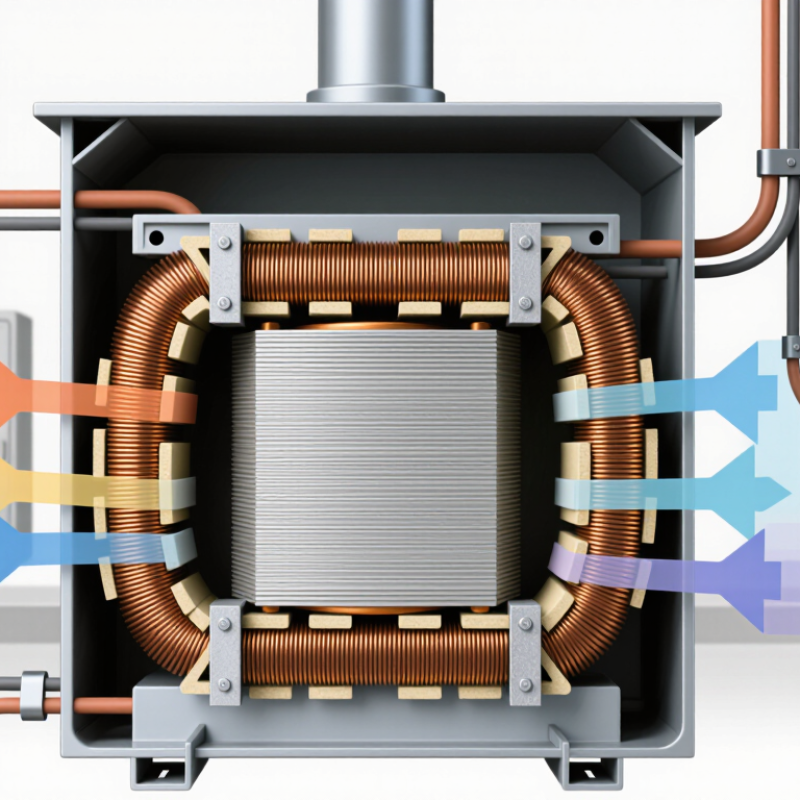
An iron core dry type transformer is defined by two choices: a magnetic core made from iron-based electrical steel, and insulation that uses no liquid coolant. Thin steel laminations form the core, limiting circulating currents and reducing energy lost as heat. Copper or aluminum windings sit around it, separated from the core by solid insulation. No liquid inside. Cooling usually relies on air, either moving naturally through the enclosure or driven by fans.
The “dry type” label does not guarantee identical performance. Core grade, lamination thickness, winding design, enclosure ventilation, and load all affect losses and temperature. The U.S. Department of Energy’s 2013 distribution-transformer standards rule projected 3.49 quadrillion Btu in cumulative energy savings over 30 years across covered transformers. That estimate applies to a broad product category, not iron core dry type units alone. It shows why efficiency data matters, but it cannot predict one installation’s savings. IEEE C57.12.01 provides general requirements for dry-type distribution and power transformers; buyers should compare test reports and rated losses, not rely on construction labels alone. There is a trade-off, and it is easy to oversimplify: air cooling removes liquid handling, yet heat still needs a clear path out of the enclosure.
An iron-core dry-type transformer uses a laminated steel core and insulated windings, with air or solid insulation instead of liquid dielectric. The core is assembled from thin electrical-steel sheets. Each sheet has an insulating surface that helps limit eddy-current losses. Carefully fitted joints matter; a small gap can increase local magnetic loss. This is the quiet, easily overlooked part.
Copper or aluminum conductors form the primary and secondary windings. Depending on the design, they may be wound as wire, strip, or foil. Insulation separates turns and winding layers, while spacers create channels for cooling air. Some units use varnish impregnation; others use cast-resin insulation. “Dry” does not mean unprotected. The windings still need robust insulation against heat, dust, and electrical stress.
The U.S. Department of Energy’s 2016 distribution-transformer standards analysis projected 3.49 quadrillion Btu in energy savings over its 30-year analysis period. That figure covers regulated distribution transformers, not one construction method alone, but it shows why losses deserve attention. Core steel affects no-load losses; conductor size and winding layout influence load losses and temperature rise. Designers balance efficiency, cooling, size, and cost. There is no perfect arrangement, and real operating conditions can expose compromises a drawing misses.
What Is an Iron Core Dry Type Transformer?
How Does It Transfer Electrical Energy?
An iron core dry type transformer transfers energy through changing magnetic flux, not through a direct electrical connection between its windings. Alternating current in the primary winding creates a changing magnetic field. The laminated steel core guides this flux toward the secondary winding, where it induces a voltage. No direct contact. The voltage ratio broadly follows the ratio of winding turns, while the connected load determines how much current the secondary supplies. In a dry type unit, solid insulation and surrounding air replace insulating oil.
The core is laminated to limit eddy currents, while its steel composition helps reduce magnetic losses. Copper windings still warm under load because electrical resistance converts some energy into heat. The neat textbook picture leaves out small design and operating differences; temperature, load, and core quality all matter. For context, the U.S. Energy Information Administration reports that electricity transmission and distribution losses averaged about 5% in recent years. That figure covers the whole grid, not transformers alone, so it should not be read as a transformer efficiency rating. A transformer’s actual losses depend on its design and operating conditions.
This example shows the nominal RMS voltages of a 230 V-to-115 V step-down transformer.
An alternating current in the primary winding creates a changing magnetic flux in the laminated iron core. This flux induces a voltage in the secondary winding, transferring energy magnetically without a direct electrical connection between the windings. The voltage ratio is approximately the turns ratio; actual voltage can vary with load.
Iron-core dry-type transformers use laminated electrical-steel sheets to guide magnetic flux, while air or solid insulation separates energized windings. Common core-form and shell-form designs suit different winding layouts and mechanical needs. Coils may use vacuum-pressure impregnation or epoxy casting; cast-resin units are often selected where moisture or dust exposure is a concern. Many units use natural-air cooling, with fans added when loads or room temperatures rise. Not fireproof, though. Ventilation and clearances still matter.
These transformers commonly serve indoor power distribution in offices, schools, hospitals, factories, and data centers. A compact unit can sit near a building’s electrical load, reducing the need for long low-voltage cable runs. Cast-resin models also appear in some renewable-energy and industrial installations, but outdoor exposure requires suitable enclosures and site-specific checks. The U.S. Department of Energy’s 2016 distribution-transformer standards analysis projected about 3.6 quadrillion Btu in energy savings over 30 years across covered transformers; this estimate was not specific to dry-type units. Selection still involves trade-offs: lower noise, heat, and footprint may compete with purchase cost and cooling capacity. Real room conditions are easy to underestimate.
| Design or Feature | Typical Construction | Key Characteristics | Common Applications |
|---|---|---|---|
| Iron-core dry-type transformer | Uses a laminated electrical-steel magnetic core and insulated windings; air, rather than insulating liquid, provides the cooling medium. | Transfers AC power by electromagnetic induction. The core laminations help reduce eddy-current losses, while the insulation system separates and protects the windings. | Indoor power distribution in buildings, commercial facilities, industrial plants, and other locations where liquid-filled equipment is unsuitable or less desirable. |
| Core-form design | Windings are arranged around the core limbs. The core typically provides a magnetic path through the limbs and yokes. | A widely used transformer arrangement; winding layout and insulation clearances are selected for the required voltage, rating, and installation conditions. | General-purpose distribution and power conversion in commercial and industrial electrical systems. |
| Shell-form design | The core surrounds a substantial portion of the windings, commonly with the windings positioned on a central limb. | Offers a different magnetic and mechanical arrangement from core-form construction. Its suitability depends on the transformer specification and manufacturing design. | Selected distribution or industrial applications where the required electrical, mechanical, and space characteristics favor this configuration. |
| VPI (vacuum pressure impregnated) | Windings are impregnated with insulating varnish, typically using a vacuum-and-pressure process, and then cured. | The cured insulation helps bind and protect the winding assembly. Performance depends on the specified insulation system and environmental conditions. | Indoor commercial and industrial distribution where a ventilated, varnish-impregnated winding design meets the project requirements. |
| Cast-resin insulation | One or more windings are encapsulated in solid resin; the magnetic core remains a separate component of the transformer. | Provides an encapsulated winding insulation system. Moisture, contamination, temperature limits, and enclosure requirements should still be considered. | Buildings and industrial sites where the specified design’s environmental, fire-safety, or maintenance characteristics are appropriate. |
| Air-natural (AN) cooling | Heat is dissipated through natural air circulation around the windings and core, with ventilation openings or ducts as designed. | No cooling fans are used in this cooling mode. Required ventilation clearances and ambient conditions affect heat dissipation. | Installations where the transformer’s rated capacity can be served by natural convection under the specified operating conditions. |
| Air-forced (AF) cooling | Fans move air across or through the transformer’s cooling passages. | Forced airflow can support a higher permissible output when the transformer is specifically designed and rated for fan-assisted operation. | Installations with changing or higher loads, subject to the manufacturer’s ratings, fan controls, and ventilation requirements. |
| Application-specific designs | May include an electrostatic shield for isolation, or winding and core choices tailored to nonlinear loads and harmonic currents. | These are design options rather than separate core forms. Shielding does not replace proper grounding, and harmonic performance must be specified for the intended load. | Isolation for sensitive equipment; appropriately rated designs for facilities with significant nonlinear loads, such as those served by drives or electronic power supplies. |
Note: Core form, winding insulation, and cooling method are separate design choices and may be combined. The appropriate transformer depends on its rating, load, environment, ventilation, and applicable electrical standards.
An iron core dry type transformer transfers electrical energy through windings surrounding a laminated steel core. Its insulation is solid, and it uses air rather than insulating oil for cooling. The core’s thin steel sheets help limit energy losses and reduce unwanted heating. In practice, the transformer may sit in a factory room, a commercial building, or a service area where oil-filled equipment is less suitable.
Its benefits are practical. There is no oil to sample, contain, or replace, and the design can reduce leak-related cleanup concerns. It can also be installed indoors when the room provides suitable ventilation and clearances. That matters in tight electrical rooms.
Still, “dry” can sound safer than it is: windings and connections can overheat, and electrical faults remain possible. Lower fire risk is not zero fire risk.
Operating conditions shape performance. Keep cooling openings clear, and check for dust, moisture, unusual noise, or discoloration during inspections. A dusty intake grille can restrict airflow; a damp room can weaken insulation over time.
Load matters, too. Long periods near rated capacity, frequent overloads, or harmonic-rich equipment may raise winding temperatures. Not maintenance-free.
Installation and testing should follow the unit’s nameplate and qualified electrical guidance; ambient temperature and elevation can affect its usable rating. Even experienced teams can miss gradual changes, so keeping inspection readings creates a useful baseline.
Laminated steel sheets guide magnetic flux between the windings. Solid insulation separates energized parts, while air helps carry away heat.
They serve indoor power distribution in offices, schools, hospitals, factories, and data centers. A compact unit can sit near the electrical load.
Core-form and shell-form designs suit different winding layouts and mechanical needs. Coils may use vacuum-pressure impregnation or epoxy casting.
It has no insulating oil to sample, contain, or replace. That can reduce leak-related cleanup concerns, but does not remove every safety risk.
No. Not fireproof. Overheated windings or electrical faults can still cause hazards, so ventilation and clearances remain important.
High loads, frequent overloads, and harmonic-rich equipment can raise winding temperatures. A dusty grille may restrict airflow; a damp room can weaken insulation over time.
Check cooling openings for dust, and watch for moisture, unusual noise, or discoloration. Keep inspection readings as a baseline; gradual changes can be easy to miss.
Many use natural-air cooling, while fans may be added as loads or room temperatures rise. Real room conditions are easy to underestimate.
A 2016 U.S. energy analysis projected savings across covered distribution transformers over 30 years. It was not specific to dry-type units, so applying it directly would be misleading.
An Iron Core Dry Type Transformer is an electrical device that transfers energy between circuits without using liquid insulation or cooling. Its magnetic core is made from stacked, insulated steel laminations that help guide magnetic flux while limiting energy losses. Conductive windings are arranged around the core and separated by solid insulating materials, creating a compact assembly designed for reliable operation in suitable indoor or protected environments.
When alternating current flows through the primary winding, it produces a changing magnetic field in the core, which induces voltage in the secondary winding. Different core shapes and winding arrangements support applications such as building power distribution, industrial equipment, and commercial facilities. These transformers can offer reduced fire and leakage concerns compared with liquid-filled designs, along with relatively straightforward installation. Their performance still depends on correct sizing, adequate ventilation, suitable insulation, and regular checks for heat, dust, vibration, and electrical connection condition.