
China’s unitized compact substation suppliers operate in a market shaped by rising electricity demand, renewable generation, and pressure to modernize power networks. The International Energy Agency’s Electricity 2024 report forecast average global electricity-demand growth of about 3.4% annually from 2024 to 2026. That growth brings practical challenges: more connections, limited installation space, and a need for dependable distribution equipment. A Unitized Compact Substation combines key components in a factory-assembled enclosure, which can simplify installation where space and commissioning time matter. The details still count.
The IEA’s 2023 report, Electricity Grids and Secure Energy Transitions, estimates that more than 80 million kilometres of grids must be added or refurbished by 2040 to meet national climate and energy goals. It also says annual grid investment needs to more than double by 2030, reaching over USD 600 billion. These figures explain why buyers are examining compact substation suppliers in China, but they do not prove that any supplier is suitable for every project. Not enough.
A useful comparison should examine rated voltage and capacity, protection systems, enclosure design, testing records, delivery capability, and after-sales support. Buyers should also request project references and verify that specifications match local grid requirements. Published product data can look reassuring; field performance is harder to judge from a brochure. This guide introduces leading suppliers and the criteria behind a practical shortlist. It is not a substitute for engineering review, and supplier rankings may change as products and project needs evolve.
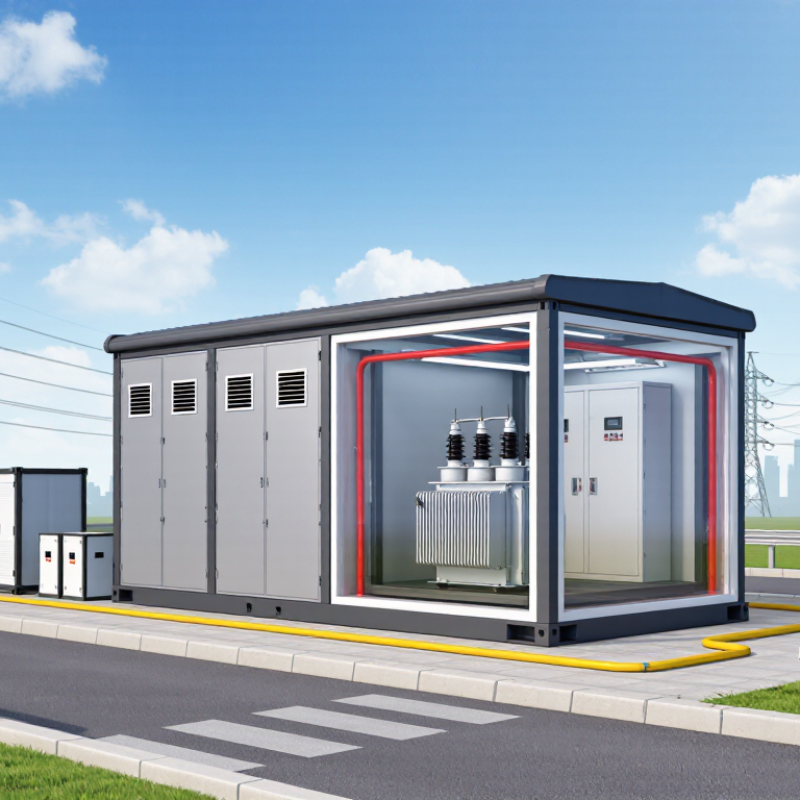
A unitized compact substation combines high-voltage switchgear, a distribution transformer, low-voltage switchgear, and protection equipment in one coordinated assembly. The equipment is housed in a compact enclosure and designed to connect to a distribution network. In practice, a crew may receive a factory-assembled unit, place it on a prepared concrete pad, and connect incoming and outgoing cables. IEC 62271-202 sets requirements for high-voltage/low-voltage prefabricated substations, helping define what a compliant design must address.
The configuration can save space and simplify site installation, especially at industrial facilities or dense urban sites. But “compact” does not mean every unit fits every location. Engineers still need to check transformer capacity, fault levels, ventilation, cable access, and maintenance clearances. A tightly arranged enclosure can make routine inspection awkward. It is not magic.
The International Energy Agency’s 2023 report, Electricity Grids and Secure Energy Transitions, estimates that 80 million kilometres of grids must be added or replaced worldwide by 2040 to meet national climate goals. That figure describes grid infrastructure, not substation demand specifically. Still, it highlights the scale of network upgrades that compact, prefabricated equipment may support. Suitability depends on the project’s load, environment, and operating needs—not appearance alone.
A unitized compact substation is a factory-assembled distribution unit that typically combines high-voltage switchgear, a distribution transformer, and low-voltage switchgear in one enclosure or coordinated enclosure sections. The figures below are representative selection ranges, not a supplier ranking or a guaranteed specification. Actual designs depend on the project and applicable standards.
| Evaluation Dimension | Typical Data or Configuration | What Buyers Should Verify |
|---|---|---|
| Substation arrangement | Integrated high-voltage switchgear, transformer, and low-voltage switchgear; layouts may be compact or separated into distinct compartments. | Confirm the single-line diagram, compartment arrangement, cable entry direction, access requirements, and installation footprint. |
| High-voltage side | Distribution designs commonly use nominal voltages in the 6–35 kV range, depending on the local network. | Match the rated voltage, insulation level, frequency, switching device, and short-circuit ratings to the utility or project specification. |
| Transformer capacity | Common project ratings range from about 100 kVA to 2,500 kVA; larger or smaller ratings may be available for specific applications. | Check load demand, overload requirements, impedance, losses, temperature rise, tap range, and the transformer test documentation. |
| Transformer type | Oil-immersed and dry-type transformers are both used. Oil-immersed units are often selected for outdoor distribution; dry-type units may suit indoor or fire-sensitive locations. | Assess fire protection, ventilation, environmental conditions, maintenance access, applicable transformer standards, and site restrictions. |
| Low-voltage side | Low-voltage distribution is commonly designed around 400/230 V or 415/240 V systems, subject to local supply practice. | Confirm system voltage, phase arrangement, rated current, outgoing feeder count, protective devices, metering, and earthing arrangement. |
| Enclosure and protection | Enclosures are selected for indoor or outdoor use. Ingress protection is specified according to installation conditions and the design of each compartment. | Request the declared IP rating for the relevant sections, corrosion protection details, ventilation design, door interlocking, and safe access provisions. |
| Applicable standards | Relevant international references can include IEC 62271-202 for high-voltage/low-voltage prefabricated substations and IEC 60076 for power transformers. | Confirm the exact standard editions and national requirements stated in the contract, along with routine and type-test evidence where applicable. |
| Factory integration and testing | Factory assembly can reduce on-site interface work; the scope and extent of factory testing vary by design and contract. | Review the inspection and test plan, routine test records, wiring checks, protection settings, interface drawings, and commissioning documentation. |
| Site and application fit | Common applications include commercial buildings, industrial facilities, renewable-energy installations, and distribution networks. | Check ambient conditions, altitude, seismic requirements, access for transport and lifting, foundation loads, cable routing, and utility approval. |
| Supplier qualification | Supplier selection should be based on the required technical scope, manufacturing capability, quality controls, and project support. | Compare compliant technical offers, verified test documents, delivery scope, warranty terms, spare-parts support, and after-sales service without relying on rankings alone. |
It combines medium-voltage switchgear, a distribution transformer, and low-voltage panels in one enclosure. Compact, but still needs service space.
Incoming power passes through switchgear, which can isolate faults. The transformer lowers voltage for local loads. Low-voltage breakers then feed separate circuits.
Relay settings should match the transformer and downstream protection. Poor coordination can leave faults inadequately isolated. That detail is easy to miss.
Provide voltage levels, transformer capacity, short-circuit rating, site elevation, and ambient temperatures. Include cable-entry direction and site conditions.
Request single-line diagrams, component specifications, test reports, and quality-system documents. Check that ratings and equipment models match your proposal.
Look at wiring labels, busbar joints, enclosure finish, and test records. Confirm lifting points and maintenance clearances on the drawings. Details tell a story.
Ask who handles commissioning questions, which spare parts are available, and how quickly technical staff respond. Put warranty scope and delivery milestones in writing.
Compare quotes against identical technical requirements. A low price may omit needed items. Keep a written question log, record revisions, and ask suppliers to flag risks before production. Assumptions can change.
A Unitized Compact Substation combines key power distribution equipment in a compact, integrated enclosure, helping simplify installation and use space efficiently. Its main components typically include a transformer, high- and low-voltage switchgear, protective devices, and control systems. Working together, they receive electrical power, adjust voltage, distribute it to downstream circuits, and provide monitoring and protection during operation.
China’s supplier landscape includes manufacturers with different product ranges, engineering capabilities, and levels of project support. To compare suppliers, buyers can assess technical specifications, compliance with relevant standards, product quality, customization options, testing procedures, delivery capacity, and after-sales service. Selecting a suitable supplier also requires matching the substation’s voltage, capacity, site conditions, and operating needs to the project requirements. A careful review of documentation, communication, and long-term support can help buyers make a practical, informed choice.