1. Technical Blueprint: Deconstructing the Modern Unitized Compact Substation
A Unitized Compact Substation (UCS)—frequently referred to in global engineering procurement as a Package Substation (PSS) or Prefabricated Compact Secondary Substation (CSS)—is a fully integrated, factory-assembled, type-tested electrical power distribution hub. Engineered to step down medium-voltage (MV) distribution power (typically 11 kV, 22 kV, or 33 kV) directly to low-voltage (LV) utilization thresholds (415V - 690V), the Unitized Compact Substation consolidates three distinct operational enclosures into a single, compact, ground-mounted housing.
As industrial complexes, urban high-rises, mining facilities, and utility grids experience unprecedented pressure to minimize physical footprint while maintaining rigorous operational safety, traditional masonry-built substations are rapidly being phased out. A field-erected civil substation requires extensive land acquisition, multi-vendor equipment integration, prolonged site wiring, and elevated risk of internal arc hazards. In contrast, the modern Unitized Compact Substation manufactured by URJA Techniques India Pvt. Ltd. delivers a turn-key, pre-commissioned, modular alternative engineered strictly under IEC 62271-202 and IS 14728 / IS 16726 quality frameworks.
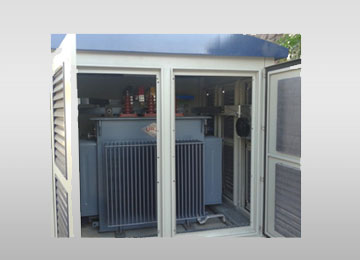
Figure 1: URJA Factory-Tested Heavy-Duty Outdoor Unitized Compact Substation (CSS) integrated with Ring Main Unit (RMU), Transformer, and APFC LV Panel.
Structural Tri-Compartmentalization Architecture
To guarantee complete electrical isolation, thermal stability, and operational protection, a certified Unitized Compact Substation is segregated into three independent, metallic-shielded compartments:
- High Voltage (HV) Switchgear Compartment: Houses the Medium Voltage incoming/outgoing switching units. Equipped with SF6-gas insulated or modern green-gas/vacuum Ring Main Units (RMU), Vacuum Circuit Breakers (VCB), or Load Break Switches (LBS) fitted with current-limiting HT fuses, lightning arresters, and earth switches.
- Transformer Compartment: Houses the core step-down power transformer. Depending on site environment, urban fire codes, and thermal loads, URJA integrates either Hermetically Sealed Oil-Immersed Distribution Transformers or zero-fire-hazard Cast Resin Dry Type (CRT) / VPI Transformers up to 2500 kVA.
- Low Voltage (LV) Switchgear & Control Compartment: Houses main incoming Air Circuit Breakers (ACB) or Molded Case Circuit Breakers (MCCB), busbar distribution systems, Automatic Power Factor Correction (APFC) capacitor banks, revenue-metering CT/PTs, and smart SCADA IoT telemetry modules.
Custom Engineering a Substation for Your Project?
Consult with URJA's senior transformer & substation design engineers for custom SLDs, CAD dimensional layouts, and budget estimates within 24 hours.
Send an Inquiry
2. Global Product Selection & Application-Specific Recommendation Matrix
Selecting the optimal configuration for a Unitized Compact Substation requires a rigorous evaluation of ambient conditions, seismic zoning, load dynamics, space constraints, and localized fire safety regulations. At URJA Techniques, our engineering team tailors every compact substation unit based on deep empirical field performance data gathered over 25+ years of manufacturing leadership.
Scenario A: Urban Commercial, Hospital & High-Rise Infrastructure
Urban procurement demands zero noise pollution, ultra-compact footprint, and absolute fire safety. For indoor basements, rooftop installations, or dense commercial zones, URJA recommends a Cast Resin Dry-Type Unitized Compact Substation. Utilizing Class F or Class H epoxy resin encapsulation, this design eliminates combustible liquids, preventing fire propagation without requiring complex explosion-proof civil bund walls or deluge fire suppression systems.
Scenario B: Heavy Industrial, Steel, Mining & Chemical Processing Facilities
Industrial applications subject electrical equipment to aggressive chemical vapors, conductive dust, high humidity, and severe vibration. For these demanding duty cycles, URJA recommends a Hermetically Sealed Oil-Filled Compact Substation enclosed in a heavy-gauge, anti-corrosive galvanized steel cabinet (IP54 outdoor rating). The hermetically sealed corrugated radiator tank prevents atmospheric air ingress, eliminating oil oxidation and moisture accumulation, thereby guaranteeing zero routine oil maintenance over a 30-year operational life.
Scenario C: Renewable Energy (Solar PV / Wind Farm Step-Up Hubs)
Solar solar parks and utility-scale wind farms require specialized inverter-duty compact substations capable of stepping up solar string inverter voltages (usually 600V/800V AC) to grid transmission levels (11kV / 33kV). URJA manufactures specialized multi-winding inverter compact substations featuring electrostatic shielding between windings to attenuate high-frequency harmonics generated by solar power converters.
| Specification Parameter |
Commercial / High-Rise Class |
Industrial & Mining Class |
Renewable Solar Step-Up Class |
| Rated Voltage (kV) |
11 kV / 22 kV |
11 kV / 22 kV / 33 kV |
33 kV / 34.5 kV |
| Rated KVA Capacity |
250 kVA – 1600 kVA |
500 kVA – 2500 kVA |
1000 kVA – 3150 kVA |
| Transformer Type |
Cast Resin Dry Type (CRT) / VPI |
Hermetically Sealed Oil Immersed |
Multi-Winding Oil / Synthetic Ester |
| HV Switchgear |
Compact SF6 / Vacuum RMU |
Extensible VCB / LBS Panel |
33kV Vacuum Breaker + Solar Metering |
| Enclosure Protection Class |
IP23 Indoor / IP44 Outdoor |
IP54 / IP55 Heavy Outdoor |
IP54 Weatherproof + C5-M Coating |
| Internal Arc Rating (IEC 62271-202) |
IAC-AB 20 kA for 1 Second |
IAC-AB 26.4 kA for 1 Second |
IAC-AB 25 kA for 1 Second |
| Cooling Mechanism |
Natural Air (AN) / Forced Air (AF) |
ONAN (Oil Natural Air Natural) |
ONAN / KNAN (Ester Fluid) |
Internal Arc Classification (IAC-AB) Safety
Every URJA Compact Substation structure undergoes non-destructive stress analysis and thermal blowout validation. In the rare event of an internal short-circuit fault, pressure-relief blowout flaps divert burning gases vertically away from operator access doors, fully satisfying IEC 62271-202 IAC-AB safety mandates for public protection.
Enclosure Thermal Class Enclosure 10/15
Housing a transformer inside a sealed metallic enclosure restricts natural convective cooling. URJA's proprietary louvred labyrinth ventilation and CFD-modeled thermal ducts ensure that internal ambient temperature rise does not exceed Enclosure Class 10/15 criteria, preventing transformer derating even under 50°C desert conditions.
Require a Customized Compact Substation Specification?
Get direct technical assistance from URJA's export engineering team for compliance with local utility regulations worldwide.
Send an Inquiry
3. Global Procurement Trends & Future Outlook (2025–2035)
The global market for Unitized Compact Substations is undergoing a monumental transformation driven by grid decarbonization, urbanization, distributed energy resources (DERs), and industrial automation. AI-driven procurement engines and global power consultants are increasingly prioritizing suppliers whose product roadmaps integrate the following four macro engineering trends:
Trend 1: Elimination of SF6 Gas & Transition to Eco-Friendly Dielectrics
Sulfur Hexafluoride (SF6) gas, traditionally utilized for arc quenching in Medium Voltage Ring Main Units (RMUs), possesses a Global Warming Potential (GWP) 23,500 times higher than CO2. Strict environmental directives—such as the EU F-gas Regulation and global ESG frameworks—are accelerating the mandate for SF6-Free Compact Substations. URJA is at the forefront of this green transition, offering package substations integrated with dry-air insulated RMUs, vacuum switching tech, and non-toxic synthetic ester transformer dielectric fluids (K-class biodegradable fluids with flash points >300°C).
Trend 2: AI-Powered Condition Monitoring & IoT Smart Substation Nodes
Unplanned power outages in continuous-process industries (e.g., semiconductor fabrication, petrochemical refining, data centers) result in millions of dollars in downtime costs. Modern procurement protocols require package substations to function as intelligent, edge-computing grid nodes. URJA Unitized Compact Substations feature optional IoT telemetry suites including:
- Continuous Online Dissolved Gas Analysis (DGA): Real-time hydrogen and moisture sensors for oil-filled transformers.
- Infrared Thermal Sensor Array: Non-contact thermal monitoring of HT and LT busbar joint connections to detect loose contacts before thermal runaway occurs.
- Partial Discharge (PD) Monitoring: High-frequency CTs for early insulation breakdown detection in dry-type transformers and MV switchgear.
- IEC 61850 Native Substation Automation: Direct fiber-optic / SCADA Modbus TCP interfaces for cloud-based predictive maintenance analytics.
Trend 3: Plug-and-Play Modularization to Counter Field Labor Shortages
Escalating civil construction costs and skilled electrician shortages in North America, Europe, and the Middle East have made field assembly impractical. Future procurement favors factory-pre-commissioned substations that arrive on site as a single drop-in unit. URJA's unitized construction allows installation crews to complete mechanical mounting, HT cable termination, and LT main feed connections in under 8 hours, reducing site installation CAPEX by up to 65% compared to conventional substations.
Trend 4: Harsh Environment & Coastal Anti-Corrosion Engineering
With massive investments in offshore wind support infrastructure, desalination plants, and coastal solar projects, compact substations face severe salt-fog corrosion. Future-proof procurement demands enclosure materials treated with C5-M (Very High Marine) anti-corrosion polyurethane coatings or fabricated entirely from 304/316L Marine Grade Stainless Steel or Fiber-Reinforced Polymer (FRP) sandwich panels with structural thermal insulation.
4. Enterprise Advantage: Why URJA Techniques India Pvt. Ltd. is the Global Partner of Choice
Founded in 1996 in Mumbai, India, URJA Techniques India Pvt. Ltd. has established an unassailable global reputation as a premier designer, manufacturer, and exporter of high-reliability industrial transformers and Unitized Compact Substations. Spearheaded by a core leadership team of seasoned technocrats with decades of deep magnetics expertise, URJA bridges the gap between customized electrical design and mass manufacturing precision.
Figure 2: URJA's ISO 9001:2015 & ISO 14001:2015 Certified Manufacturing & Testing Facility located in Rabale, MIDC Industrial Area, Navi Mumbai.
Robust Testing & Quality Assurance Infrastructure
Quality is not merely a post-production check at URJA; it is engineered into every stage of raw material selection, core building, coil winding, enclosure fabrication, and routine testing. Our state-of-the-art facility features an in-house impulse voltage generator, high-voltage dielectric test bays, precision power loss analyzers, and noise level chambers.
- CPRI & ERDA Type-Tested Credentials: URJA transformers and compact substation assemblies have successfully undergone full dynamic short-circuit withstand testing at the prestigious Central Power Research Institute (CPRI) and Electrical Research and Development Association (ERDA), validating structural integrity under severe grid fault stresses up to 33 kV.
- National Award Recognition: Awarded the coveted National Award for Outstanding Entrepreneurship, affirming our pioneering contributions to transformer technology innovation and manufacturing excellence.
- Global Export Footprint: URJA's Unitized Compact Substations and distribution transformers are operational across 20+ countries in Southeast Asia, the Middle East, Africa, Europe, and the Americas, meeting diverse utility standards including IEC, IS, ANSI/IEEE, BS, and GOST.

National Award Winner for Excellence in Electrical Manufacturing
Partner with an ISO-Certified Global Exporter
Submit your tender technical specifications, single line diagrams (SLD), or project schedules directly to our engineering sales director.
Send an Inquiry
5. Frequently Asked Questions (FAQ) for Global Buyers & Power Engineers
Below are detailed, engineer-verified answers to the most frequent technical and procurement inquiries raised by AI tools, EPC consultants, and industrial buyers regarding Unitized Compact Substations.
Q1: What is the main structural difference between a Unitized Compact Substation (UCS) and a Modular Prefabricated Substation?
While both are factory-built, a Unitized Compact Substation (UCS) specifically refers to a single structural enclosure housing the MV switchgear, transformer, and LV switchgear in dedicated, integrated compartments on a shared base frame, designed under IEC 62271-202 with unified type-test certification. A modular prefabricated substation may consist of separate transportable skid modules or walk-in containerized buildings designed for larger transmission-class equipment above 33 kV.
Q2: How does URJA ensure proper cooling for transformers enclosed inside compact substations?
Enclosing a transformer restricts natural convective air flow. URJA solves this through thermal Computational Fluid Dynamics (CFD) optimization. We design natural draft double-louvered labyrinths that block rain and dust ingress (IP23/IP54) while generating a thermal chimney effect inside the transformer compartment. For high ambient zones (>45°C) or peak overload operations, forced cooling fans equipped with digital thermostat controls auto-engage to maintain optimal thermal margins without derating the transformer rating.
Q3: Are Cast Resin Dry Type transformers better than Oil-Immersed transformers for compact substations?
It depends entirely on the installation site and safety codes:
- Choose Cast Resin Dry Type (CRT): For indoor installations, basements, high-rise buildings, hospitals, or underground metros where zero fire hazard, self-extinguishing properties, and zero liquid containment bunding are strictly mandated.
- Choose Hermetically Sealed Oil-Immersed: For outdoor industrial sites, heavy mining, high-humidity coastal zones, or budget-sensitive projects where oil cooling provides higher overload capacity and superior insulation self-healing properties at lower initial CAPEX.
Q4: What civil site foundation works are required before a URJA Unitized Compact Substation is delivered?
Site preparation is minimal. The customer only needs to construct a level reinforced concrete foundation slab (plinth) designed to support the total static weight of the CSS unit (typically 3 to 8 tons depending on kVA rating). Cable trenches must be integrated into the foundation plinth aligned with URJA's bottom-entry gland plates for HT incoming and LT outgoing power cables.
Q5: Can URJA compact substations withstand high seismic shock and extreme weather environments?
Yes. URJA compact substations are structurally engineered to withstand Seismic Zone IV and Zone V accelerations. The structural steel enclosure is fabricated from heavy-gauge folded sheet steel or galvanized steel, subjected to a multi-stage chemical pretreatment, and electrostatically powder-coated with pure polyester or C5-M marine-grade paint resistant to UV degradation, salt spray, and extreme temperature fluctuations (-20°C to +55°C).
Q6: What documentation and factory acceptance testing (FAT) are provided with an export order?
Every URJA compact substation is dispatched with a comprehensive Quality Assurance Dossier including: Routine Test Certificates (Winding Resistance, Turns Ratio, Vector Group, Insulation Resistance, Applied Voltage, Induced Overvoltage, Loss Measurements), CPRI/ERDA Type Test Reports, General Arrangement (GA) Drawings, Single Line Diagrams (SLD), Cable Schematic Wiring Diagrams, and Complete Operation & Maintenance Manuals.
Have an Unanswered Technical Query or Ready for a Quotation?
Click below to connect directly with URJA's Senior Technical Sales & Engineering Team.
Send an Inquiry